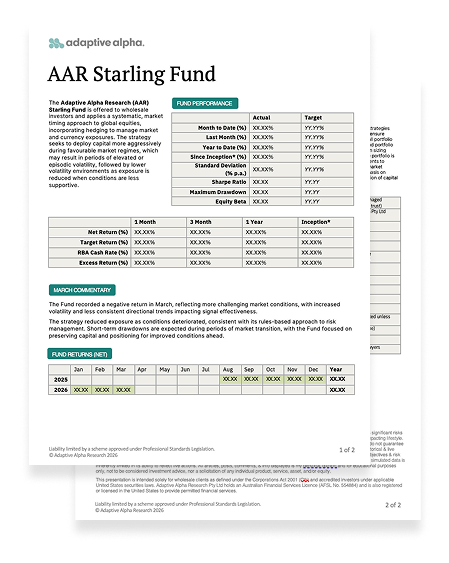

PERFORMANCE OVERVIEW
Starling Fund

Starling is the flagship implementation of the Adaptive Alpha Research framework. Australian-domiciled and trading across 19 ETF markets since July 2025 — systematic, rules-based, and built to behave the same way in every market condition. The numbers below are live. Real capital, real positions, no backtested smoothing.

Fund Performance

After all fees, as at 31-Mar-2026 Actual Target
Returns
Last Month % −4.75
3 Months %
Year to Date % −1.71
Since Inception (4-Aug-2025) % 2.89 7.80
Current Month to 22-Apr-2026 % 1 5.72
Statistics
Unit Price (AUD) 1.0289
Sharpe Ratio 2 0.03 0.67
Standard Deviation (%pa) 3 9.4 12.0
Maximum Drawdown % 4 −11.3
Beta to Equities 5 0.72 0 – 0.3
Frequency of Positive Months (%) 87.5
¹ Unofficial estimated figure  ·  ² Annualised  ·  ³ Annualised  ·  ⁴ Peak to trough  ·  ⁵ Rolling 12-month

Monthly Returns

JanFebMarAprMayJun JulAugSepOctNovDec Year
2025 0.161.07 0.591.900.89 4.68
2026 1.231.93 −4.75 *5.72 *3.91
* Estimated month to date, unofficial · All figures are total return · Past performance is not indicative of future results

Cumulative Return Since Inception

Cumulative Return Since Inception — After All Fees
Estimated MTD
Official NAV
Target (Cash+8%pa)
10% 9% 8% 7% 6% 5% 4% 3% 2% 1% 0% Aug-25 Sep-25 Oct-25 Nov-25 Dec-25 Jan-26 Feb-26 Mar-26 Apr-26
Official NAV verified end of month · Estimated MTD is unofficial and subject to change · Target: RBA Cash Rate + 8%pa · Past performance is not indicative of future results

Notes to Fund Performance

  1. Estimated return for the current month-to-date when this report was created. All other returns and statistics are calculated as at the date of this report.
  2. Sharpe Ratio is calculated using monthly returns. The numerator is the monthly return of the unit class over the RBA Cash rate. The denominator is the standard deviation from Note 3 below.
  3. Standard Deviation uses the monthly return of the unit class, multiplied by the square root of 12 to annualise it.
  4. Maximum Drawdown uses the compounded estimated daily return series, from each peak to the next trough.
  5. Beta to Equities is the slope of the line of best fit in a linear regression equation with the monthly return of the unit class over the RBA cash rate versus the monthly return of the SPY ETF over the Fed Funds rate.

Important Disclosures

Historical Performance, whether Live or simulated,may not be indicative of Future performance. Trading Equities, FX, &Futures involves significant risks of loss, which may not suitable for allinvestors. Investors should only choose to invest funds they can afford tolose, without negatively impacting lifestyle. Price characteristics are notpredictable or repetitive, thus any strategy developed using historical datawill be equally unpredictable. We do not guarantee nor claim our solutions willperform positively and/or reflect their historical results. In fact, there canbe significant differences between historical & live results. Pleaseconsult your investment professional before choosing a trading or investingstrategy, to ensure it meets your investment objectives & risk tolerances.All metrics and data shared are historically simulated, not live/real, andcannot accurately reflect live trading conditions. As all simulated data isinherently limited in its ability to reflect live actions. All articles, posts,comments, & info displayed is my personal opinion and for educationalpurposes only, not to be considered investment advice, nor a solicitation ofany individual product, service, asset, and/or equity.

This presentation is intended solely for wholesaleclients as defined under the Corporations Act 2001 (Cth) and accreditedinvestors under applicable United States securities laws. Adaptive AlphaResearch Pty Ltd holds an Australian Financial Services Licence (AFSL No.554884) and is also registered or licensed in the United States to providepermitted financial services.

What to look for:
Three metrics tell most of the story: Sharpe ratio measures return earned per unit of risk; maximum drawdown shows the worst peak-to-trough decline; and standard deviation tracks whether risk is being managed to target. A fund can have a rough month and still be behaving exactly as intended — these figures show whether the framework is working, not just whether markets cooperated.

Apply to Invest Today

Download the Performance Report

Stay up to date with our latest strategy performance.

Download the Performance Report

Stay up to date with our latest strategy performance.

Download