


Our investment process is built on rigorous quantitative research, combining academic insights with practical market experience to identify systematic patterns that persist across market conditions.
Unlike static approaches, our models continuously adapt to changing market regimes. This flexibility allows us to maintain performance across different economic environments and market cycles.
Sophisticated risk controls are embedded throughout our investment process. We focus on managing downside risk while maintaining exposure to positive market opportunities.
We construct diversified portfolios across the world's most liquid equity markets, with holding periods designed to capture medium-term return opportunities while maintaining significant capacity.
Traditional strategies stay fully invested, exposing capital even when market conditions are unfavorable.
Fixed approaches work until they don't. Markets evolve, but static strategies can't adapt to new regimes.
Over-fitted models perform well in backtests but fail in live markets where conditions have changed.
Markets change. Our rules-based framework identifies regimes, stays selective during unfavourable conditions, and re-enters when dislocations create opportunity—aiming for resilience and consistency over time.
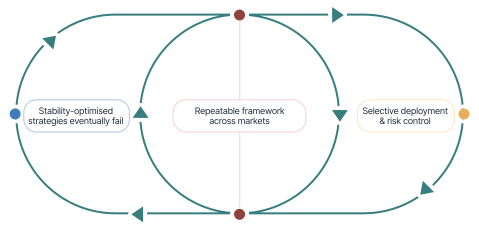
Markets evolve. Strategies optimised for stability eventually fail.
Regime shifts and over-optimisation create fragility.
A repeatable framework applied across multiple markets
Backtestable rules. Multiple models. No discretion. Applied consistently across markets and conditions
Why selective re-entry works
Market stress creates dislocations. A rules-based framework lets us stay out, then re-enter at the right moment.
Often inactive, selectively engaged
Capital is deployed only when market conditions justify the risk. This episodic approach improves risk-adjusted returns over full market cycles.
Risk is not an overlay. It is embedded in every decision, every signal, and every position.
Pre-defined rules govern every trade, removing emotion and enforcing discipline.
Multiple independent models reduce reliance on any single market outcome.
Position sizing and market exposure adjust dynamically with changing conditions.
Capital preservation is prioritised through strict downside controls and risk limits.
Outcome: Consistent risk-adjusted returns with controlled volatility across market environments.
Rules-based, credibly repeatable strategies backed by rigorous research